My Research Agenda
My research focuses on how we assess and foster non-observable competencies (such as dispositions and character traits). Drawing on my background in both assessment and learning design, I study how these competencies are measured, how instruction can be designed to develop them, and how emerging technologies like generative AI are reshaping what competencies students need.
Assessment and Measurement
I investigate how dispositions and related competencies are currently defined, measured, and valued in higher education. Through systematic reviews, surveys of computing professionals and faculty, and a cross-institutional Delphi study, I work to identify what assessment approaches exist, where the gaps are, and how we can build more rigorous tools.
Instructional Design
As part of the Educating Character Initiative (ECI) Project, I design and study learning experiences that aim to develop students' character development. This includes a design-based research study on interactive case studies in engineering capstone courses and an investigation into how students reason through professional dilemmas--what they prioritize, how they justify their choices, and how character traits show up in their decision-making. I also apply this work in practice through my instructional design role with FIRST Robotics mentors, creating inclusive training resources.
AI in Education
GenAI is raising urgent questions about responsible use, professional judgment, and ethical decision-making. I explore this space through a meta-analysis of GenAI as instructional material, a study on how pre-service teachers engage with AI tools, and research on how CS students use GenAI in their work. This line connects directly to my core interest: AI is both changing the competencies students need and offering new ways to support learning.
Methodology
Systematic Reviews & Meta-Analysis
Map how dispositions, competencies, and GenAI are defined, assessed, and used across large bodies of literature.
-
SLR of Disposition Assessment Methods in Higher Education (Under Review)
-
SLR of Research Instruments for Disposition Assessment in Higher Education (Ongoing)
-
Generative AI as Instructional Material: A Meta-Analysis of Student Achievement in Higher Education (Ongoing)
Surveys & Delphi Research
Surface what computing professionals and faculty value and how they reach consensus on what matters.
-
Importance of Dispositions on the Job: Survey of Computing Professionals (FIE 2024)
-
How Computing Professionals and Faculty Rank Dispositions and Cross-Disciplinary Skills (FIE 2025)
-
Codifying Character for Engineering and Computing Education: A Delphi Study (Ongoing)
Design-Based Research
Build and iteratively refine learning experiences in authentic settings.
Mixed-Methods Studies
-
Examining Pre-service Teachers’ Engagement with AI Tools: Patterns, Perceptions, and Ethical Considerations (Ongoing)
-
GenAI Use in Computer Science: Insider Perspectives to Inform Practice (Ongoing)
-
Understanding the Design Thinking Mindset Among Adolescents in Grades 7-12 (Ongoing)
Peer Reviewed Publications
-
Exter, M., Yakut, N., Tagare, D., & Sabin, M. (2025). WIP: How do computing professionals and faculty rank the importance of dispositions and cross-disciplinary skills? 2025 IEEE Frontiers in Education Conference (FIE), 1–5. https://doi.org/10.1109/fie63693.2025.11328210
-
Yakut, N. (2025). Work-in-progress: Systematic review of competency assessment methods in computing education. Proceedings of the 56th ACM Technical Symposium on Computer Science Education, 1764–1764. https://doi.org/10.1145/3641555.3705060
-
Yakut, N. & Önen, E. (2025). Comparison of classification accuracy and consistency indices under the item response theory. International Journal of Educational Studies and Policy, 6(1), 90–105. https://doi.org/10.5281/zenodo.15075438
-
Exter, M., Yakut, N., Sabin, M., Tagare, D., & Ashby, I. (2024). Work in progress: Importance of dispositions on the job: Survey of computing professionals. 2024 IEEE Frontiers in Education Conference (FIE), 1–5. https://doi.org/10.1109/fie61694.2024.10893432
Manuscripts Under Review
-
Yakut, N., Duan, S., Exter, M. (Under Review). A systematic literature review of disposition assessment methods in higher education. Instructional Science.
 |  |
|---|---|
 |  |
 |
Conference Presentations
-
Roodi, F., Yakut, N., Watson, W. R. (2026). GenAI use in computer science: Insider perspectives to inform practice [Poster Presentation]. American Educational Research Association Annual Meeting (AERA), Los Angeles, CA, United States.
-
Yakut, N. & Roodi, F. (2025). Empowering teacher with AI: Practical tools for creative & inclusive lesson planning [Oral Presentation]. Purdue AI in P-12 Education Conference, West Lafayette, IN, United States.
-
Yakut, N., Yilmaz Yenioglu, B., Yenioglu, S., Aktan, S. (2025). Examining pre-service teachers' engagement with AI tools: Patterns, perceptions, and ethical considerations [Concurrent Session]. Association for Educational Communications and Technology Annual Meeting (AECT), Las Vegas, NV, United States.
-
Yenioglu, S., Yilmaz Yenioglu, B., Yakut, N. (2025). AI-Driven interventions for students with learning disabilities: A future perspective [Presidential Session]. Association for Educational Communications and Technology Annual Meeting (AECT), Las Vegas, NV, United States.
-
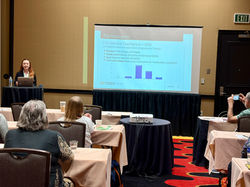
Yakut, N. (2025). Systematic review of disposition assessment methods in higher education [Roundtable Presentation]. American Educational Research Association Annual Meeting (AERA), Denver, CO, United States.
-
Yakut, N. (2025). Work-in-Progress: systematic review of competency assessment methods in computing education [Student Research Competition]. The Technical Symposium on Computer Science Education (SIGCSE TS), Pittsburgh, PA, United States.
-
Yakut, N. & Zywicki, C. (2024). Agreements, contracts, or compacts: Uncovering the expected learning in mentor-mentee relationships [Live Oral Presentation]. ConnectUR 2024 Annual Conference, virtual.
-
Yakut, N. & Childress, A. (2024). Bridging theory and practice: Enhancing career readiness through undergraduate research [Share and Solve]. ConnectUR 2024 Annual Conference, virtual.
-
Yakut, N. (2023). The effects of intelligent tutoring systems on students' motivation in mathematics education: A systematic literature review [Poster Presentation]. Annual Graduate Student Education Research Symposium (AGSERS), West Lafayette, IN, United States.
-
Yakut, N. & Onen, E. (2022). The comparison of classification accuracy indices within the scope of item response theory [Paper Presentation]. International Young Researchers Congress-II (GUGAK-2022), virtual.